
The moon tonight
Tonight’s moon as a globe, lit from where the sun really is at that hour and standing as it stands over Le Morne. Turn it, come closer, name its seas.
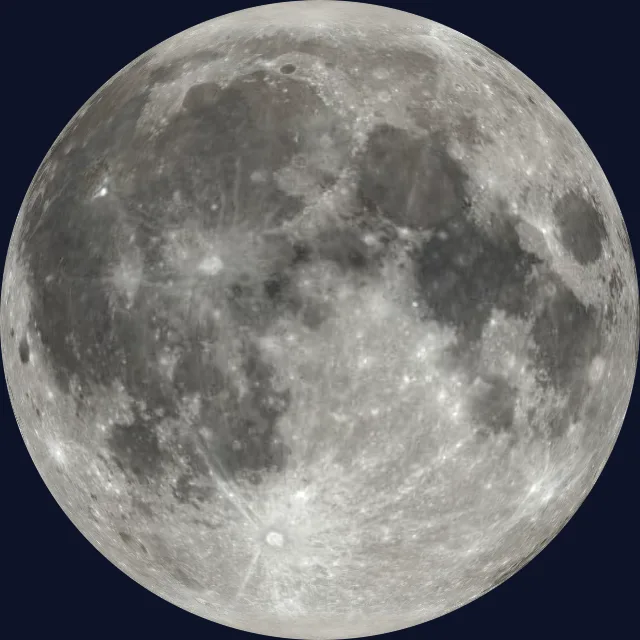
Waxing gibbous
Calculated61% lit, 8.4 days since new moon, at 19:00 on the night of Wednesday 18 November.
Over Le Morne it stands 76° up in the north; the top of the picture is overhead.
It shows 6.8° more of its western edge, past the Ocean of Storms and 1.6° more of its south, past Tycho and Clavius.
How it is drawn
- Calculated
- The light: the sun’s direction from the moon at the hour you choose, from the scene’s own sun and moon (the NOAA solar equations and a shortened Meeus lunar series), so the lit side and the phase are those of that hour. The stance: the moon’s axis by Cassini’s laws, its nod toward us (the libration, Meeus chapter 53, to about a fifth of a degree) and the zenith over Le Morne at the top of the picture, as you see it from the beach. The same arithmetic as the rest of “The sky”.
- Observed
- The surface: NASA’s colour map of the moon from the Lunar Reconnaissance Orbiter’s camera, 1024 by 512 points, and its relief from the orbiter’s laser altimeter, which shades the craters and ridges along the line between day and night. NASA says the colour map is made for appearance, not for science.
- Illustrative
- The moon’s glow is not drawn, nor the air’s haze or colour near the horizon; the dark side’s faint earthshine is set by eye. The names stand on the centres of the seas and craters and move with the moon as you turn it.
The names on the moon
Seas
- Sea of Rains Mare Imbrium
- Sea of Serenity Mare Serenitatis
- Sea of Tranquillity Mare Tranquillitatis
- Sea of Crises Mare Crisium
- Sea of Fertility Mare Fecunditatis
- Sea of Nectar Mare Nectaris
- Sea of Clouds Mare Nubium
- Sea of Moisture Mare Humorum
- Ocean of Storms Oceanus Procellarum
- Sea of Cold Mare Frigoris
- Sea of Vapours Mare Vaporum
- Sea of Islands Mare Insularum
- Known Sea Mare Cognitum
Craters
- Tycho 43.3° S, 11.2° W
- Copernicus 9.6° N, 20.1° W
- Kepler 8.1° N, 38.0° W
- Aristarchus 23.7° N, 47.4° W
- Plato 51.6° N, 9.4° W
- Clavius 58.4° S, 14.4° W
- Ptolemaeus 9.3° S, 1.9° W
- Grimaldi 5.2° S, 68.6° W
- Langrenus 8.9° S, 61.1° E
- Theophilus 11.4° S, 26.4° E
- Archimedes 29.7° N, 4.0° W
- Proclus 16.1° N, 46.8° E
Places from the IAU’s Gazetteer of Planetary Nomenclature, to a tenth of a degree. On the moon east is toward the Sea of Crises, the edge that faces the sunrise there.
Calculated for 20.45° S, 57.32° E on your device, from the scene’s own astronomy; the moon’s surface from NASA’s Scientific Visualization Studio’s CGI Moon Kit (svs.gsfc.nasa.gov/4720), credited as NASA asks; NASA does not endorse this site. Nothing about you is kept. For the moon coming up over the ridge, Where the moon rises; for the month ahead, the moon calendar.